


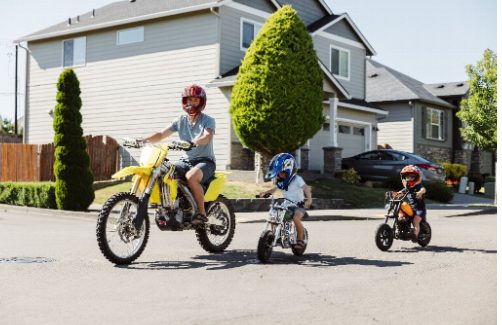
Children often want a smaller version of whatever fascinates the adults they love. A child who watches a parent polish a motorcycle, choose a helmet, or talk about a weekend ride may soon announce, “I want one like yours.” That request is not always about speed or machinery. Often, it is a request to join the story.
For families, that enthusiasm can become a meaningful source of screen-free play. The goal is not to recreate an adult riding experience for a child. It is to build an age-appropriate family ritual around imagination, responsibility, and time together. With thoughtful planning, the motorcycle theme can continue long after the first burst of excitement has passed.
Start With the Part Your Child Loves
Before shopping, ask what makes motorcycles interesting to your child. Is it the shape, the sound, the special clothing, or the feeling of doing something alongside Mom or Dad? The answer can inspire activities that do not require riding at all.
A child can design a paper license plate, choose a nickname for a pretend bike, draw a family route, or create a garage sign. Parents can set up a simple “service station” with soft cloths and toy tools. Even choosing a short family playlist can turn preparation into part of the fun. Brands such as HYPER GOGO reflect the growing interest in child-sized motorcycle designs, but the strongest memories usually come from what families do together around the experience.
Make Research a Parent-Child Project
If the family decides to consider an electric ride-on, involve the child in the research without letting appearance make the decision. Parents should check the manufacturer’s stated age, height and weight guidance for the specific model. HYPER GOGO says its child-sized models include safety-focused features such as adjustable speed settings, sturdy frames, wide tires and braking systems. Regardless of these features, children should wear a properly fitted helmet and protective gear, ride on flat surfaces away from traffic, and remain under adult supervision. They should also consider the child’s current riding experience, the available riding space, storage, charging arrangements, replacement parts, and whether an adult can supervise every session.
Features vary considerably between products and even between versions from the same manufacturer. Training-wheel compatibility, speed settings, controls, lights, audio features, and app functions should never be assumed. Confirm each feature on the exact product page and manual. A model that looks exciting in a photo may not be the right physical or practical fit for a particular child.
Turn Family Rules Into Part of the Game
Rules feel less like interruptions when they are introduced as part of the riding identity. Create a short pre-ride routine that the child can help lead: helmet fastened, suitable closed-toe shoes on, riding area checked, vehicle inspected, and supervising adult ready. Choose one clear stop signal and practice responding to it before each session begins.
Parents should select a dry, level, obstacle-free area where motorized ride-ons are permitted. A child-sized electric motorcycle should not be treated as public-road transportation. Families should not assume that neighborhood streets, sidewalks, bike paths, or public parks allow its use. Local rules, property restrictions, manufacturer guidance, and direct adult supervision all matter.
Plan for Northeast Ohio Weather
Northeast Ohio families know that a sunny afternoon can quickly become wet, cold, or windy. Build a routine that works even when riding is postponed. On indoor days, children can decorate a storage sign, make a checklist, plan a pretend route, or learn how adults inspect equipment before use. The vehicle should remain switched off and stored according to the manufacturer’s directions during these activities.
When conditions are suitable, set up a simple course on permitted private property using soft, highly visible markers. Avoid tight turns, slopes, standing water, loose gravel, traffic, pedestrians, and parked vehicles. Change the activity instead of increasing the challenge: practice smooth starts, stopping at a marker, following a boundary, or parking in a designated spot.
Choose the Experience, Not Just the Object
Families comparing options can use a collection such as Mini Bike for Kids as a starting point for understanding the different styles available. From there, narrow the choices using fit, manufacturer guidance, the family’s riding environment, and the level of supervision required. A familiar-looking design is appealing, but suitability should lead the decision.
The best family traditions also give children responsibilities that match their age. They might return protective gear to its place, help wipe away dust, remind an adult about the checklist, or decide when weather makes it better to wait. Praising those choices shows that being a rider includes patience and care.
A Smaller Motorcycle, a Bigger Connection
When a child says, “I want a motorcycle like yours,” parents can hear more than a request for a new toy. It may be an invitation to share an interest, build a ritual, and spend focused time together away from screens.
A child does not need a miniature version of every adult experience. What matters is a version shaped for the child’s size, maturity, environment, and family rules. The motorcycle may begin the conversation, but the lasting value comes from planning together, practicing good habits, and giving a child a genuine place in something the family already loves.
