


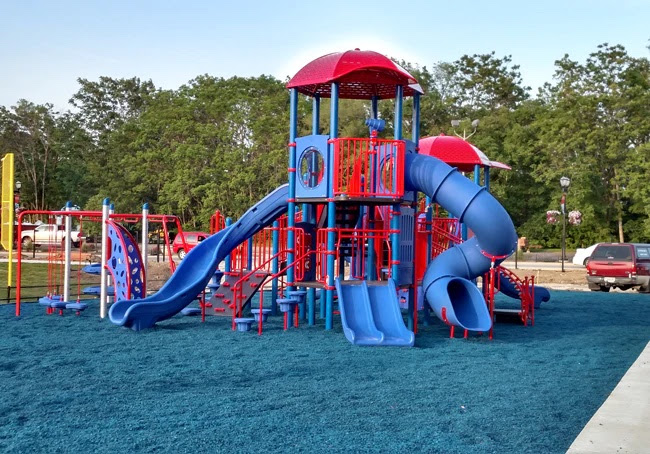
June is National Safety Month, which is an excellent opportunity for families, schools, and communities to focus on preventing injuries and creating safer environments for children. While parents often think about bike helmets, car seats, and sunscreen, one of the most overlooked safety factors is right beneath their feet: playground surfacing. Whether it’s at a school, local park, daycare, or in their own backyard, the surface beneath playground equipment plays a major role in how serious a fall-related injury can be.
One of the biggest misconceptions about playground safety is the belief that grass, soil, or packed dirt are “soft enough” to cushion a fall. While these surfaces may appear safe, they do very little to absorb impact energy. Grass quickly wears thin in high-traffic areas beneath swings, slides, and climbing structures. Dirt also becomes compacted over time, creating a hard surface that offers minimal protection during falls. And while it’s commonly used for playground surfacing, traditional wood mulch can compact, scatter, and freeze in colder climates. This reduces its ability to meet safety performance standards over time.
Understanding HIC Scores and Playground Safety
One of the most important measurements in playground safety is the Head Injury Criterion, commonly referred to as HIC. HIC scores are used to evaluate how effectively a playground surface reduces the force of impact during a fall and the likelihood of a serious head injury. In simple terms, lower HIC scores indicate better protection.
This distinction matters because many playground surfaces can technically meet ASTM fall safety standards while still providing far less impact protection than higher-performing alternatives. Materials like engineered wood fiber may pass testing initially, but their safety performance can diminish as they compact, shift, or freeze.
Impact-absorbing rubber surfaces, by comparison, consistently achieve significantly lower HIC scores, as it offers greater protection against severe head injuries. For parents and communities, this is an important shift in perspective. Playground surfacing should not simply be viewed as a box to check for compliance purposes. It should be viewed as critical protective equipment; every bit as important as helmets, seatbelts, and other child safety measures.
Why Rubber Playground Surfacing Outperforms Traditional Materials
Rubber playground surfacing is specifically engineered to absorb impact and cushion falls. Whether using rubber mulch or poured-in-place rubber systems, these surfaces are designed to reduce the force transferred to a child’s body and head during an accident. Unlike grass or dirt, rubber surfaces maintain a flexible, shock-absorbing structure that helps soften landings. High-quality rubber mulch products can far exceed ASTM standards for impact attenuation. It provides a much higher level of protection than traditional loose-fill materials.
Rubber mulch also offers practical long-term advantages over wood mulch and other alternatives. It is less likely to compact, decompose, or scatter outside play zones. It also maintains more consistent depth coverage, which is essential for preserving fall protection over time. In colder regions, rubber remains more resilient and does not freeze into a hard surface the way wood-based materials often can.
There are also persistent misconceptions surrounding rubber playground surfacing and health concerns. However, modern playground rubber products have been extensively studied and continue to demonstrate strong safety performance. Cur
Proper Installation and Maintenance Still Matter
Even the safest playground surface requires proper installation and maintenance to remain effective. For loose-fill rubber mulch systems, experts generally recommend maintaining a depth of at least three to four inches, depending on equipment height and manufacturer specifications. Over time, playground materials naturally shift through use and weather exposure, making regular inspections important.
Schools, parks, daycare centers, and homeowners should routinely:
- Rake displaced material back into high-traffic areas
- Check for thinning beneath swings and slide exits
- Replenish material as needed
- Inspect for proper coverage around all equipment
