


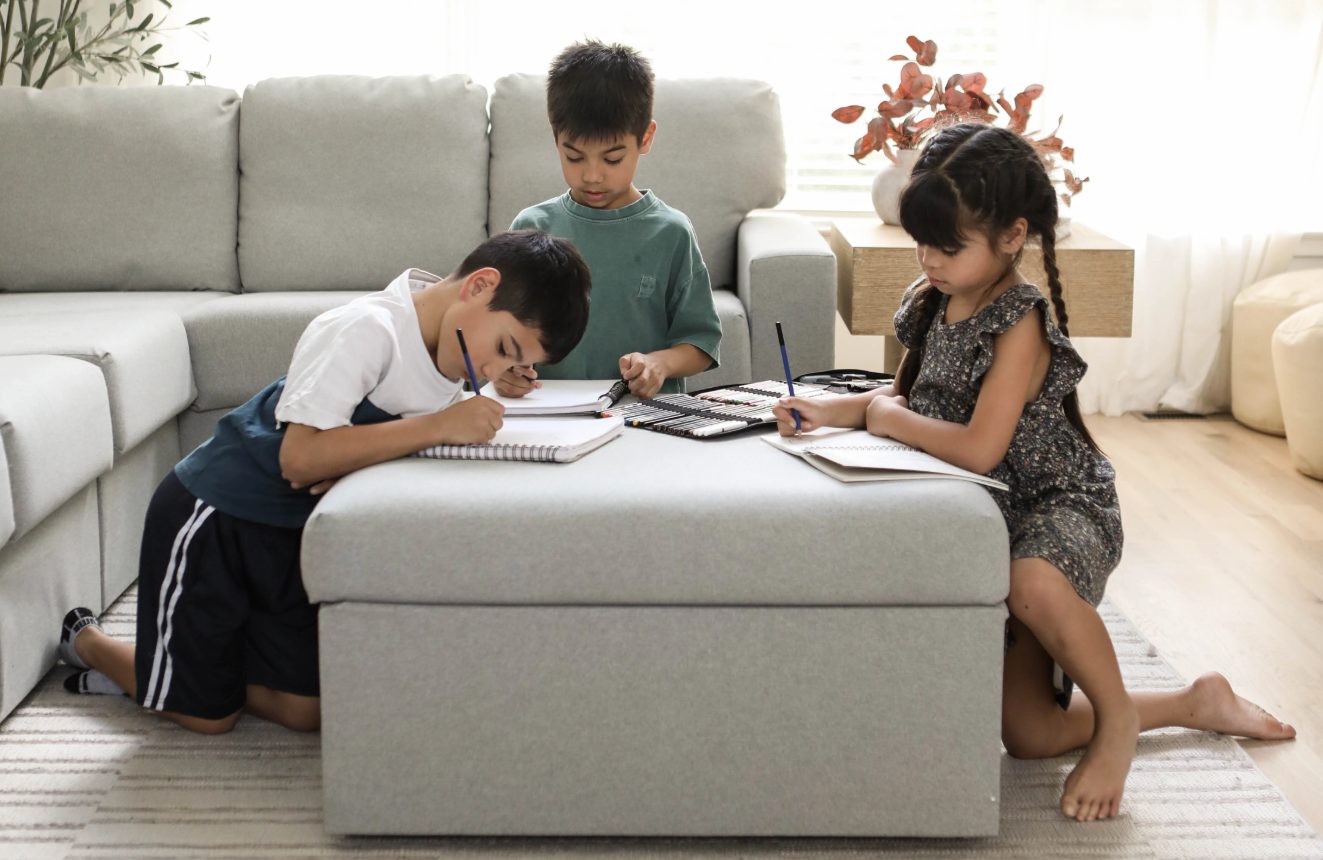
On a typical Tuesday evening, the living room often acts as a playroom, homework station, and adult retreat all at once.
Instead of fighting this reality, specific arrangements help the shared space function beautifully for everyone.
While modern families rely heavily on technology, as research shows digital habits vary widely among children, physical play areas remain essential.
Incorporating a few smart design choices can turn a chaotic, multi-use room into a calming environment.
1. Make Space for Kids’ Imaginations Without Letting Them Take Over
Giving kids’ passions intentional real estate in the living room keeps their current obsessions from colonizing every other surface.
Frame this not as a compromise, but as a dedicated corner for imagination. For younger kids, this might mean a sensory play area or a canopy reading nook with soft floor cushions.
As kids grow into tweens and teens, the corner naturally evolves to support new interests.
Corkboards can hold fantasy campaign maps, worldbuilding notebooks, and costume brainstorming sketches.
For older children interested in historical reenactment or cosplay, one well-chosen display piece transforms the area entirely.
A piece of medieval armor like a pauldron on a shelf becomes both décor and a costume anchor.
Safety must remain the top priority when active imaginations run at full speed. Data indicates a high volume of toy-related injuries treated in emergency rooms each year, with a significant portion impacting the head and face area.
Use soft foam replicas for younger children to prioritize safe play over visual authenticity. For teens, mount any heavy display-only pieces securely on wall hooks well out of small hands’ reach.
| Important: Imagination shouldn’t compromise safety. Use soft foam replicas for young children. For teens, always mount heavy display pieces securely on wall anchors, verified stable and well out of reach. |
2. Choose Seating That Cleans Up as Hard as Your Family Plays
Nothing disrupts family relaxation faster than hovering over the living room with a cleaning towel.
Spilled juice, stray craft supplies, and muddy paw prints are simply realities of an active household.
Choosing a cozy couch with family-friendly features removes this constant anxiety and lets everyone relax.
Look for seating options with machine-washable fabrics so that a sudden spill stops being a crisis.
Furniture that unzips for washing and shifts configuration easily does not ask your family to live more carefully.
It just makes recovery from how they actually live almost effortless. Modular pieces are especially helpful because they let the room evolve as your family grows.
Whether you opt for performance fabric options or slipcover-style sofas, practical features make a huge difference.
Prioritizing hidden storage under seat cushions for blanket overflow or disappearing charging cables adds immense value.
These functional choices give you the peace of mind to actually enjoy the room together.
3. Zone the Room for Play and Rest
In most homes, family members share the exact same square footage while doing completely different things.
This inevitably leads to building blocks migrating toward the adult seating area. The secret to managing this collision is using intentional furniture placement to create invisible boundaries.
Start by anchoring the adult seating cluster on one end of the room. On the opposite end, define a distinct play space featuring a soft rug and low storage bins.
A console table or low bookcase placed between these areas functions as a brilliant visual divider.
This arrangement preserves sightlines, which is critical for parents who need to monitor the room at a glance.
Even living rooms under 200 square feet respond well to this thoughtful zoning logic. The moment kids have a defined play zone, cleanup instructions become incredibly simple.
Every toy goes back to the rug end, and adult downtime stops feeling like stolen minutes.
4. Add Storage That Doesn’t Shout Storage
Every active family desperately needs stashing space, but nobody wants a living room that reads like a daycare.
Furniture that effortlessly doubles as storage is the real solution to this daily tension. Seek out double-duty design elements like an ottoman with a lift-off lid for board games.
A window bench for dress-up clothes or built-in seat compartments for blanket overflow also work perfectly.
This storage disappears into the furniture rather than announcing itself to guests. You can also utilize wall-mounted shelves placed at kid height for library books and current artwork.
Natural fiber baskets blend seamlessly with adult décor while keeping small toys out of sight.
When every item has a designated, invisible home, the five-minute tidy actually works. The room earns its restful feeling before the evening even begins.
| Key Insight: The real secret to a tidy living room isn’t more bins, it is furniture that hides storage. Ottomans, bench seats, and under-couch compartments keep chaos invisible, making five-minute cleanups actually work. |
Your Next Steps
Transforming your living room does not require a full renovation or a massive budget. It just takes a targeted weekend reset where everyone pitches in to reorganize.
Use this scannable family room refresh plan to reclaim your space on a Saturday morning.
| Time Block | Task |
|---|---|
| 0:00 to 0:30 | Declutter the zones by returning migrated items to their designated home zones. |
| 0:30 to 1:00 | Redefine the play zone by repositioning the rug and wiping down common surfaces. |
| 1:00 to 1:30 | Freshen the seating by running washable covers through the washing machine if needed. |
| 1:30 to 2:00 | Update the imagination corner by rotating display pieces and swapping in new library books. |
Light a candle, start a family playlist, and settle into the space you just made together. A home that works for your family does not need to be perfectly pristine.
It just needs a few smart setups and furniture that meets real life exactly where it is.
