


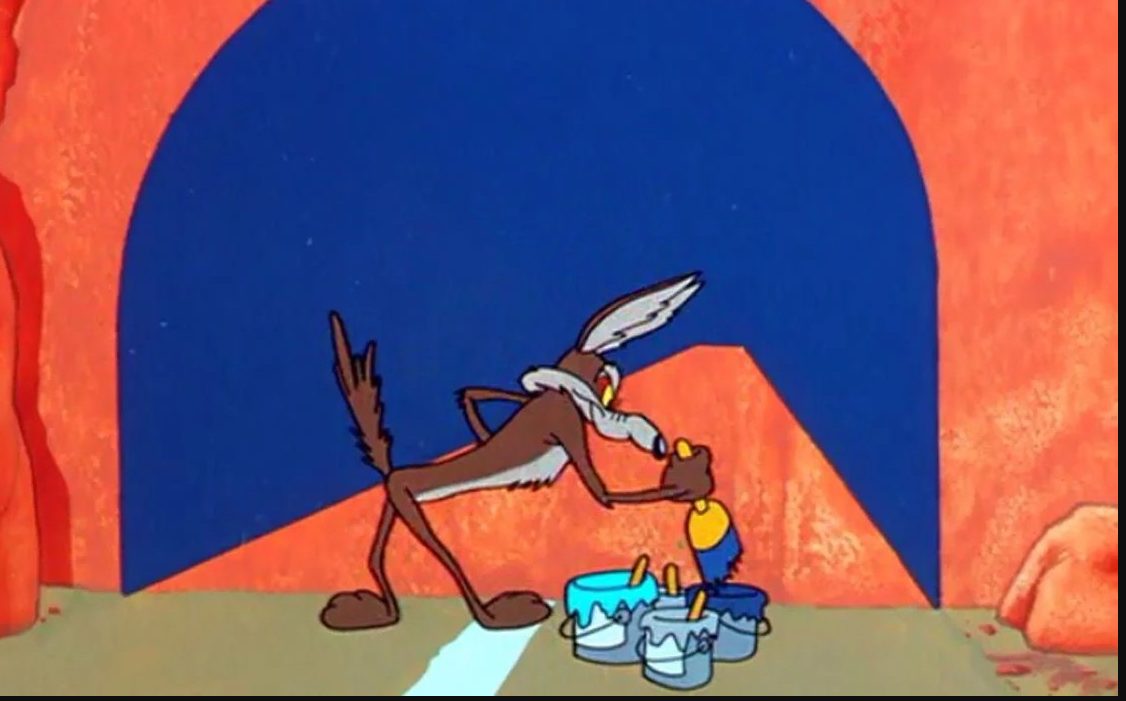
A rock wall does not become a tunnel just because someone paints one on it. Everybody watching the old chase cartoons knows this, which is exactly why the joke lands: the coyote sprints into a tunnel that a bird slips through, and the difference between them was never about physics. Painted shadows and a receding road convinced a predator at full speed that solid rock had opened up in front of him, which is a fair description of a real security vulnerability. Fool the observer, not the world, and the world stops mattering. A camera bolted above a loading dock, paired with a detection model, does not experience physics either. It reads pixels. Researchers have spent years proving how far that gap can be pushed, using stickers and printed patches instead of animation cells. None of it needs a stolen password or a breached server. It just needs to know what the model looks for, then hand it something else wearing that shape. Businesses running cameras on assembly lines or delivery routes are turning to outside computer vision development services to build and test these systems, and the sales conversation rarely opens with a cartoon reference. Not yet, anyway.
It should, a little. Adversarial patches, the technical term for these printed tricks, exploit a gap a model’s accuracy score never shows. A stop sign covered in a few stickers can register to a trained classifier as a speed limit sign, while a driver glancing at the same intersection sees graffiti and keeps braking anyway. Teams that specialize in building and validating computer vision applications have started treating this gap as a design constraint from the first sprint, rather than a patch applied after launch. A cheap kind of insurance, really.
The Trick That Only Works on Cameras
Here is the part that unsettles people once they understand it: the pattern does not need to look like anything. Early versions used bright, almost childish blotches of color; fooling a person walking past was never the point. Object detectors score each region of an image, and a patch optimized against that scoring can push a model’s confidence for “empty background” high enough that a person standing in frame disappears from the output. Researchers have called the result an invisibility cloak, hardly an exaggeration once the demo footage runs. Wear the right printed fabric, walk past a surveillance camera at the right angle, and the detection log has a gap where a person should be. No alarm. No log entry.
Look at one of these newer patches next to an older sticker from 2019: today’s version could pass for graffiti, a logo, or a water stain on concrete. One recent survey of patch attacks across classification, detection, and segmentation models traces exactly this shift, from crude, obviously artificial blotches toward designs meant to blend into a scene, so a human reviewer glances past them without a second thought. That is the sharper problem for a business relying on a camera to make a decision: counting inventory, flagging a trespasser at 2 a.m., or telling a forklift when to stop.
When the Joke Stops Being Funny
Autonomous vehicles do not get to laugh this off. A taxonomy published by the National Institute of Standards and Technology documents real cases of self-driving systems swerving into oncoming lanes and stop signs misread as speed-limit postings during testing, not thought experiments. Facial recognition gates a patch can slip past, retail cameras miscounting a queue, and drone inspections reading a cracked pipeline as intact: the pattern keeps widening.
80 techniques, and climbing. That is roughly the current count in MITRE’s ATLAS, a running catalog of documented attacks against machine learning systems, drawn from actual incidents rather than lab exercises. Physical patches sit on that list next to data poisoning and model theft, proof of how mainstream this attack category has become. Not a university lab curiosity anymore.
What This Actually Means for a Business Running Cameras
None of this means every camera on a loading dock is one sticker away from disaster. It does mean the question worth asking has shifted, from “does it work” toward “what happens when someone wants it to fail.” A handful of checks separate teams that have thought this through from those that have not:
- Ask whether the model has been tested against printed patches and stickers, not only clean, well-lit sample images.
- Find out if the vendor tracks published attack techniques on a schedule, the way a security team tracks known flaws.
- Check whether detection confidence gets logged and reviewed, so a sudden drop on one camera raises a flag instead of rounding to zero.
- Confirm a human review step sits between “camera flags an event” and “action gets taken automatically,” for anything with real consequences.
- Push for a clear answer on what happens if a patch or sticker shows up in frame tomorrow, rather than a general assurance that the model is “well-tested.”
A vendor offering computer vision development services who has worked through this will have a specific answer to each one, not a shrug and a reference to overall accuracy numbers.
Building Vision Systems That Expect the Ambush
Firms offering computer vision development range from boutique shops handling a single use case to larger engineering companies running dozens of builds at once. N-iX, a software engineering company with client work in manufacturing, logistics, and retail, treats adversarial testing as part of standard delivery, not a specialty add-on bolted on after something goes wrong. A model hitting 98% accuracy on a clean validation set, one that has never met a sticker or an oddly patterned jacket, has not been tested against what it will face once it leaves the lab.
Good computer vision application development looks less like training one model and shipping it, and more like building a system that keeps working once the world stops cooperating: retraining schedules, adversarial test sets refreshed as new techniques surface, monitoring that treats a strange drop in confidence as a signal worth chasing, not noise. Companies evaluating an outside partner should ask about all three before signing anything. None of it is glamorous, and most of it never makes the product demo.
Conclusion
The joke about the coyote and the painted tunnel works because everyone watching already understands that pictures are not the same thing as the world they depict. A camera and a detection model carry no such understanding unless someone builds it in, deliberately, test by test. Businesses putting cameras to work on decisions that matter are better served treating that gap as a design requirement from the outset, not a surprise discovered after deployment. The wall was never actually a tunnel. Getting a machine to notice that, reliably, remains the harder trick.
