


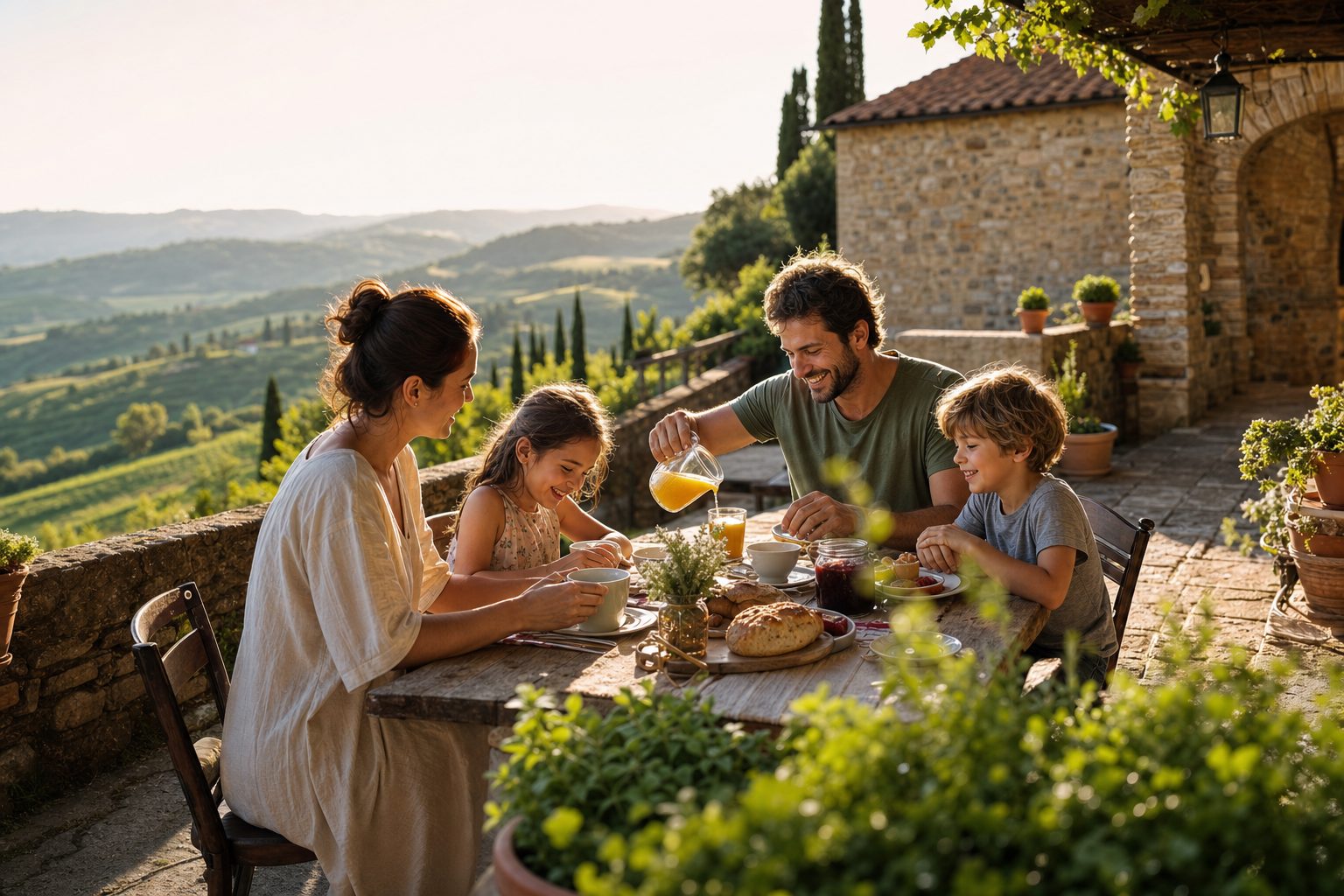
Alt text: Family enjoying outdoor breakfast with scenic countryside view.
The foundation of peaceful family vacations relies on practical habits like embracing fewer stops and pacing daily activities.
Instead of treating a getaway like a stressful productivity sprint, smart parents prioritize rest over endless sightseeing.
Adopting these targeted strategies transforms chaotic, over scheduled itineraries into restorative adventures where everyone actually enjoys the journey together.
We have all experienced the stark contrast between a trip that feels like work and one that actually feels like a break.
Finding options for curated European travel alongside resources like state park guides or local tourism boards can help you plan trips that do not drain your energy.
Peaceful family travel is not about doing more or seeing more. It is about choosing deliberately and protecting the open spaces where the real memories happen.
1. Embrace Fewer Stops and More Connection
The seductive logic of packing every possible destination into a single trip consistently backfires when children are involved.
Instead of checking off a massive list of cities, the calmest travelers rely on home basing.
This means anchoring your trip in one or two locations and exploring outward, rather than packing up and moving every single night.
Imagine a farm stay in Tuscany where the kids start recognizing the local baker by name, or a cottage along the coast where you have enough free afternoons to find a favorite beach path.
Home basing creates room for breakfasts without checkout pressure and spontaneous playground stops.
Younger children especially need fewer transitions to stay emotionally regulated. Older kids and teens engage more meaningfully when they have the time to truly explore a neighborhood.
Staying in one place allows families to reap the deep relational benefits of their time away.
Research shows that family vacations enrich a child’s education and bring relatives closer together.
Aim for a minimum of three nights per base to settle into a genuine rhythm before moving on to a new destination.
2. Build Days Around Kid Friendly Pacing
Adults often want to move from a museum to a walking tour to a late dinner, but that pacing works against the reality of traveling with children.
The single highest return change a family can make is adapting their daily itinerary to match their youngest traveler.
This targeted pacing helps prevent the common meltdowns that ruin expensive afternoon outings.
Pacing should adapt closely to the ages of your children. For young children under six, plan a morning castle visit followed by a long picnic and an unhurried nap.
Tweens and younger teens might prefer a hands on cooking class in the morning followed by unstructured time wandering an open market.
Older teens often thrive when given a morning experience they chose themselves, followed by independent afternoon hours.
Logistically, remember that jet lag affects kids differently than adults. Avoid early morning tour bookings for the first two days to prioritize natural daylight and reset internal clocks.
Always verify that all family passports are valid for at least six months beyond your return date before booking anything.
Pack a small supply of familiar snacks from home for unpredictable transition moments when hunger and exhaustion arrive simultaneously.
| Pro Tip: Adopt the “one main activity per day” rule: schedule one morning adventure, then leave afternoons free for spontaneous fun. This pacing dramatically reduces meltdowns and keeps everyone engaged. |
3. Master the Art of Downtime and Flexible Meals
Deliberate downtime is not wasted time, as it is the structural glue that holds a family trip together.
Leaving room in the schedule prevents afternoon meltdowns and the resentment that builds when everyone is overly tired.
Block out at least two to three unscheduled afternoon hours every day for hotel pools, public parks, or simply wandering without a destination.
Giving each child a small backpack with their own entertainment, such as a sketchpad, ensures parents are not the sole source of engagement during slower moments.
Just like at school, unstructured downtime improves memory and helps children stay focused later in the day. These quiet moments let everyone recharge before evening activities.
Food flexibility is equally vital to keeping the peace. A market picnic on a park bench often beats a stressed forty minute search for a restaurant.
Pair these easy picnics with an early reservation at a reliably welcoming spot, or an occasional self catered evening at your rental.
Reframing simple meals as a highlight rather than a compromise leads to more spontaneous conversation.
4. Let Someone Else Handle the Complicated Logistics
The bigger and more exciting the family trip, the more logistical complexity quietly stacks up beneath it.
A multigenerational trip abroad or a two week adventure involving multiple airports is thrilling to imagine but quietly overwhelming to actually plan.
Parents often drain their energy before the trip even begins by mapping routes that avoid one night stays.
It also takes massive effort to select hotels that genuinely welcome kids and coordinate reliable airport transfers.
For families considering a complex trip, handing the logistical architecture to dedicated planners is incredibly helpful.
Look for agencies or concierges that design itineraries from scratch around a family’s actual pace, interests, and ages rather than fitting them into a preset mold.
You can explore curated planning partners alongside self booking tools like booking platforms or direct airline portals to see what fits your needs.
The goal is not to outsource the adventure, but rather to show up for it fully.
The Bottom Line
Peaceful family vacations are built on restraint, presence, and knowing when to hand the complicated parts to someone who has already solved them.
The moments families remember longest are the unhurried afternoons, spontaneous laughter, and simple picnics eaten on a stone wall.
These moments only happen in the open spaces of a trip, rather than the packed ones.
Letting experts handle the logistics is the smartest way to protect your peace while the continent opens up around you.
| Author Profile: Tenon Tours is the leading boutique tour operator of customized European journeys for curious travelers seeking authentic, meaningful connections. |
