


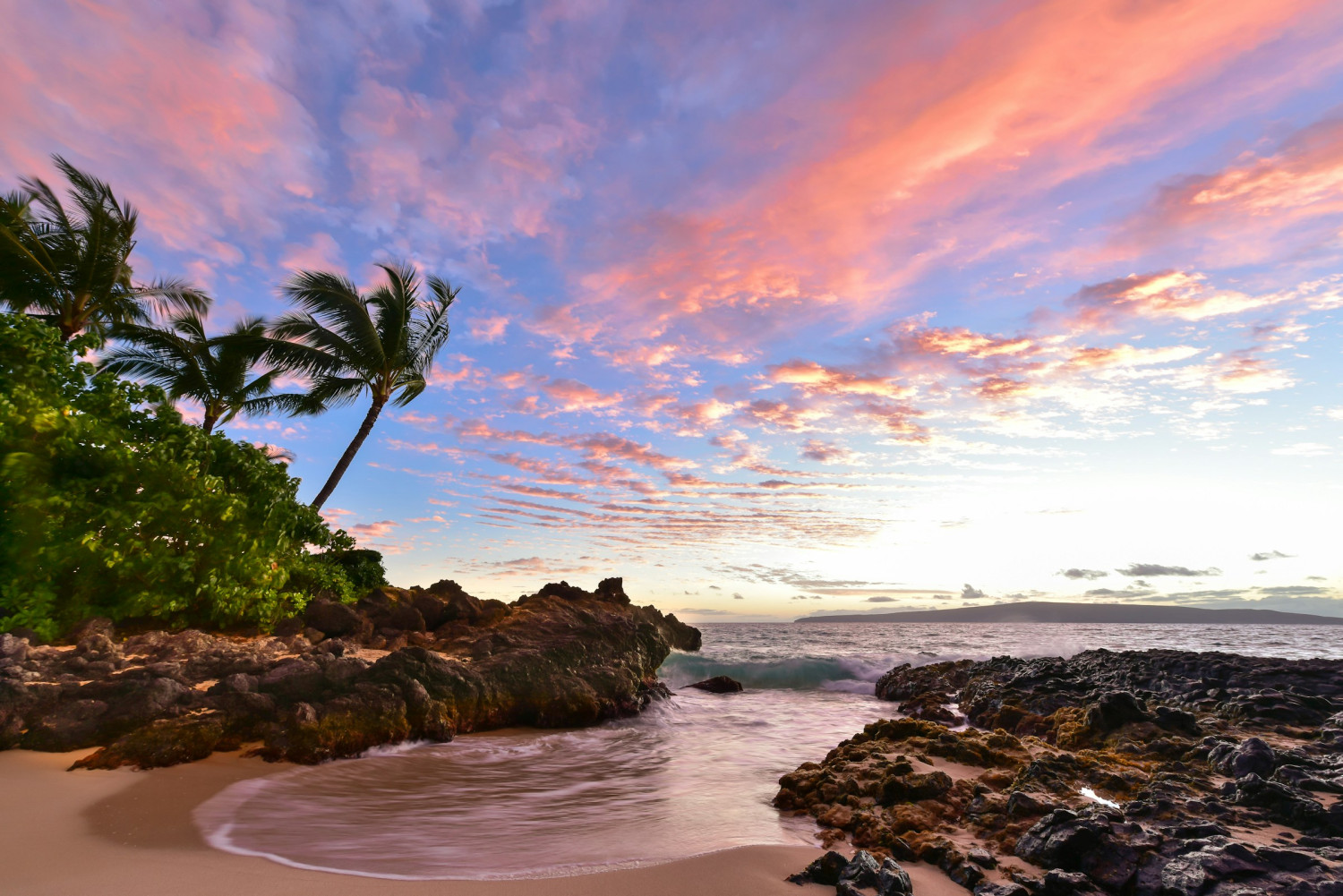
There is a moment that happens on Maui that doesn’t happen the same way in Cancún or the Bahamas. It’s not about the resort or the view or the quality of the mai tai. It’s something quieter and harder to name.
Somewhere around day four or five, after the jet lag has worn off and your body has stopped running on its old schedule, you notice that your kids have stopped asking for screens. They’re building something in the sand or chasing waves or just sitting still watching the light change. You notice that you’ve stopped checking the time. The urgency that usually hums beneath everything you do has faded, and in its place is something that feels like relief.
Research shows that children who spend regular time outdoors have milder ADHD symptoms and strengthened immune systems, but the phenomenon that unfolds on Maui extends beyond the documented health benefits of fresh air and sunlight. It’s the pace. The light. The way people seem to inhabit their days differently.
Families who vacation on Maui often describe a specific psychological shift, one that begins as relaxation and then deepens into something that resembles reorientation. The island doesn’t just slow you down. It changes the way you think about what a day should feel like.
This is when the conversation starts to shift. Usually in the second half of a trip, often over breakfast or during a quiet drive along the coast, someone says it out loud. Not “this is incredible,” but “what would it actually take.” And once the question is on the table, it doesn’t go away.
The pull of Maui is different from the pull of other aspirational vacation destinations because the infrastructure for permanence is already there. Maui has actual neighborhoods, not just resort corridors. It has year-round schools, farmers markets, grocery stores, and a rhythm of daily life that exists independent of tourism. You can see people living here, not just vacationing here, and that visibility matters.
The difference is felt in specific places. South Maui, spanning Kihei to Wailea, offers a range of residential density and price points.
Kihei provides more affordable housing options and beaches while Wailea offers luxurious living and snorkeling, creating a gradient that allows families to imagine different versions of the same life.
Upcountry, stretching through Makawao and Kula, offers cooler temperatures and more space, a different kind of Maui that feels less like a postcard and more like a place where people grow food and raise kids without constantly performing island life.
These aren’t tourist zones with a few locals mixed in. They’re communities with schools, sports leagues, and the ordinary texture of long-term residency. That stability makes the fantasy feel less like a fantasy and more like a question worth answering.
When the Fantasy Becomes a Question Worth Answering
The research phase looks different for families who get serious. It starts with cost of living comparisons and spreads into schooling options, remote work feasibility, and the often-underestimated complexity of physically relocating to an island.
Maui consistently ranks as one of the most expensive places to live in the United States, and newcomers are often caught off guard by rising insurance premiums, HOA fees, property taxes, and everyday expenses. The spreadsheets get longer.
The questions get more specific. What does it actually cost to ship a car? How long does household freight take to arrive? What happens if your belongings sit in a container for two weeks?
Moving to Maui is categorically different from moving across the mainland.
Everything you own that travels with you goes by ship or by air, and the logistics, costs, and timelines that come with ocean freight are entirely different from what applies to a standard interstate truck move. Most families have no prior experience with this kind of move. Everything arrives by barge or air.
The logistics of getting your household there require planning that feels closer to international relocation than domestic transition. The difference between a smooth move and a chaotic one often comes down to who handles the physical logistics and how far in advance the planning begins.
Families relocating to South Maui tend to work with Wailea Movers, local moving specialists who understand the island’s delivery windows, storage constraints, and the logistical realities of getting furniture and belongings into communities like Wailea or Kihei without damage or delay.
Planning and expertise are essential to sustain Hawaii’s supply chain without disruptions, and most shipping needs to be done on a just-in-time basis due to limited storage capacity on the islands.
The relocation learning curve on Maui is steep enough that most families who’ve done it recommend building the logistics plan well before the move date rather than treating it as the last thing to figure out. This is not a decision you make in February for a March move. This is a decision that requires months of preparation, coordination, and the kind of attention to detail that most people don’t associate with a move until they’re already in the middle of one that’s going badly.
What catches people off guard is how much of the emotional weight of the decision is tied to logistics they’ve never had to think about before.
The decision to relocate is at least partly determined by factors outside of one’s control, such as employment or educational opportunities, remarriage considerations, or location of extended family. But for families drawn to Maui, the practical threshold question becomes: can we actually make this work, or are we just in love with the idea?
The Financial Reality and What Housing Actually Costs
Maui’s natural beauty is world-renowned, but the cost of living can be a stark contrast, and understanding expenses from housing and transportation to groceries and utilities is essential. The sticker shock hits hard. The housing that $600,000 buys on the mainland gets you something fundamentally different on Maui.
Roughly $1.1 million to $1.2 million for single-family homes
represents the median price point in many desirable areas. The rental market offers some flexibility for families testing the commitment before buying, but availability is limited and prices reflect that scarcity.
The post-pandemic shift intensified what was already a tight market.
The 2023 Lahaina fire reshaped Maui’s housing market as displaced families absorbed much of the rental inventory, driving rents up and availability down. That pressure is felt most acutely in West Maui, but it ripples across the island. Central Maui, including Kahului and Wailuku, remains the most practical housing option for working families, but even there, competition is fierce.
What surprises people is the breadth of unexpected costs. Shipping a car from the mainland runs several thousand dollars. Private school tuition can exceed $20,000 annually.
Groceries run 30% above mainland prices, gas averages $4.80 per gallon, and electricity can hit $400 per month.
Everything costs more because most goods are shipped in. The premium extends to contractors, home repairs, and even routine services that feel affordable elsewhere. Families who thought they had their budget figured out often discover they were off by 20 to 30 percent once they start living the reality rather than modeling it on a spreadsheet.
The rental versus buy question becomes a test of commitment. Renting first allows families to learn neighborhoods, test whether island life actually fits, and avoid locking into property in the wrong location.
But the rental market is competitive enough that finding the right place at the right time requires luck and patience. Buying offers stability but comes with the psychological weight of permanence. You’re not just moving. You’re staying. And for some families, that weight is clarifying. For others, it’s paralyzing.
Thinking about how to create a family vacation that kids will love versus planning a permanent move requires a completely different framework. A vacation can be magic without being sustainable. A relocation has to be both.
What Daily Life Actually Looks Like for Families Who Made the Move
The trade-offs people don’t fully anticipate show up in the first six months. Isolation from extended family hits harder than expected. Grandparents can’t just drive over for Sunday dinner. If your child gets sick and you both work, the backup systems you relied on don’t exist here.
Regular access to green space provides several health benefits for children, however children today spend less time outdoors, making it important to understand what drives and limits children’s activities in nature. On Maui, the outdoors becomes the default rather than the exception, which is transformative for some families and disorienting for others who realize they miss the structure of scheduled activities and indoor routines.
Limited specialist healthcare is another reality that doesn’t show up in the tourism brochures. For routine care, Maui is fine. For anything specialized, you’re flying to Honolulu or considering the mainland. That’s manageable until it’s not. Families with children who have specific medical or educational needs face a much steeper adjustment curve than families whose needs are straightforward.
The things people say they’d never go back on are specific and consistent. The outdoors as a default rather than a weekend treat. The way time moves differently when you’re not constantly scheduling around traffic and obligations.
The community feel that develops when you see the same people at the farmers market, the beach, and your kid’s school. The absence of a real winter. The ability to be outside almost every day of the year without planning around weather. These aren’t small things. For families who thrive here, they’re the things that make everything else worth it.
What people wish they’d known earlier is equally consistent. That it takes longer to feel settled than they expected. That the first year is harder than the vacation made it seem. That the fantasy version of island life and the daily reality of island life are related but not identical. That logistics matter more than they thought.
The fact is that Maui is still part of the US but feels functionally different in ways that take time to learn. That the best decision they can make before committing is to come back for a longer visit, rent a place in a neighborhood rather than a resort, and live like a resident for two weeks to see what the rhythm actually feels like.
The Difference Between Researching and Going
Most people who start researching never go. They run the numbers, realize the cost, and decide the trade-off doesn’t work for their family. That’s not failure. That’s clarity. The families who do go tend to share a few characteristics.
They have location flexibility in their work. They have financial reserves that extend beyond the cost of the move itself. They’ve visited Maui multiple times and understand the difference between vacation energy and daily life energy. They’ve talked to people who’ve made the move and asked the hard questions about what didn’t work the way they expected.
The difference between the families who go and the families who don’t often comes down to one thing: whether they can separate the dream from the decision. The dream is easy. The decision is hard. The dream is about sunsets and slowing down.
The decision is about shipping timelines, school enrollment deadlines, and whether your income can sustain a cost of living that’s 60 percent higher than what you’re used to. The families who make it work are the ones who can hold both at the same time. The ones who love the dream enough to do the work the decision requires.
For families serious about understanding the transition, the path forward is specific. Visit again, but differently. Stay in a neighborhood, not a resort. Drive the routes you’d drive if you lived here. Shop where you’d shop. Spend time in the towns where you’d actually build a life, not the ones that look good in photos. Talk to families who moved here three years ago and ask them what they underestimated. Build the logistics plan before you fall in love with a house.
Understand that interstate relocation is no longer a linear calculation, it’s a complex decision balancing multiple factors, and population movement continues from northern regions to smaller metro areas. Recognize that the pull you feel is real, but so is the weight of what it takes to act on it.
And if you go, go knowing that the island will give you something you didn’t have before, but it will also ask for something in return.
