


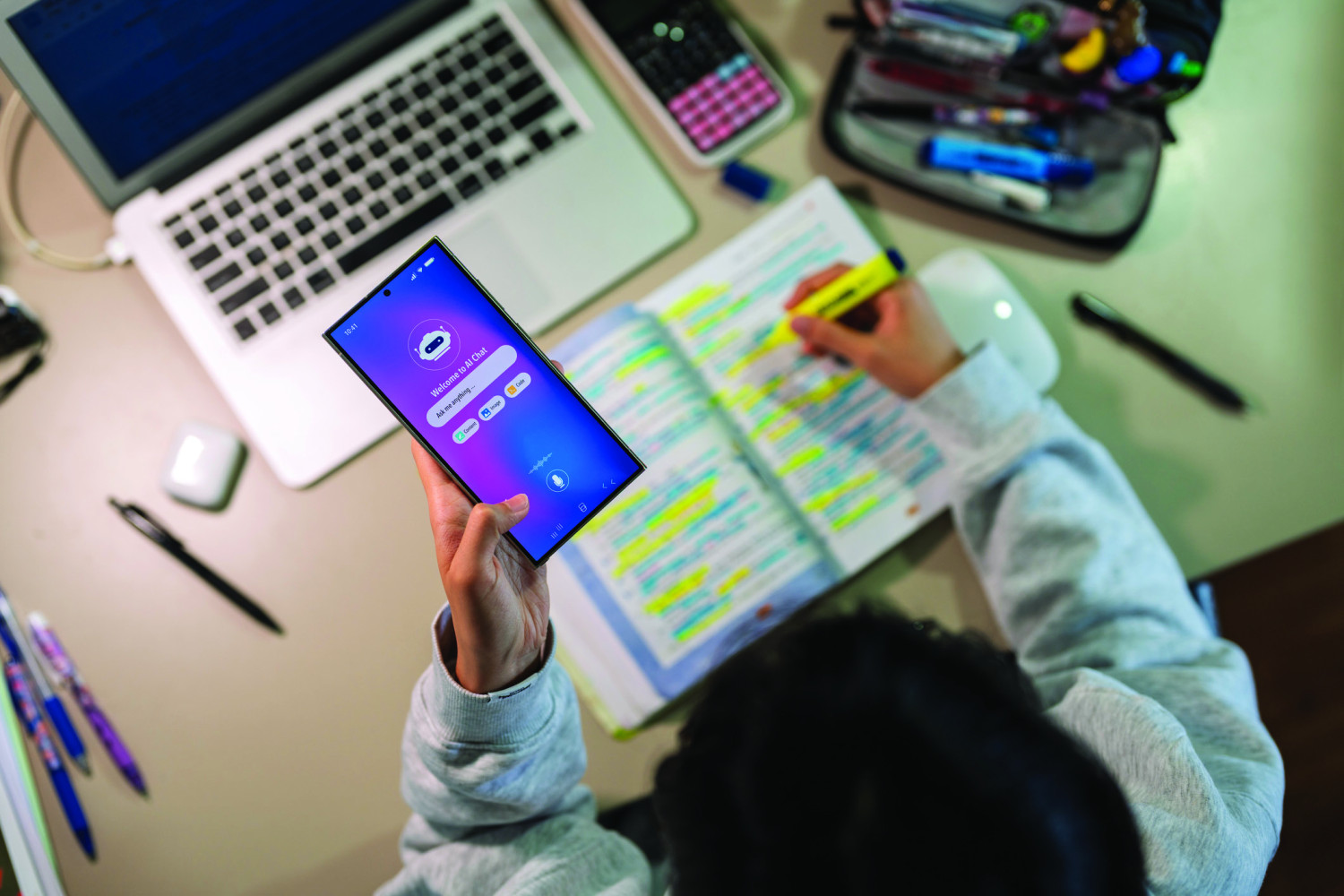
According to Pew Research, 54% of teens who use artificial intelligence use it for schoolwork, while 42% use it to summarize books, articles or videos. As AI explodes in popularity, many high school students increasingly use it in their daily lives. Now, high schools across the country are dealing with a major question: whether, and how, to thoughtfully integrate the technology into the classroom and promote the ethical use of AI.
How High School Students Are Using AI
Jeff Rainer, an AP U.S. history and government teacher at Streetsboro Public Schools and College Board speaker, observes students interacting with AI in a variety of ways.
“Some use it appropriately to brainstorm ideas, clarify difficult concepts, receive feedback, create study materials, or improve their writing,” he explains. “Others use it as a shortcut by asking AI to complete an entire assignment without understanding or evaluating the response.”
Students view AI as a normal part of their digital world, but Rainer says that they still need explicit instruction to “maintain their own voice and thinking.”
That reliance on shortcuts has created many challenges for academic integrity.
Eric Ling, dean of faculty at Cuyahoga Valley Christian Academy (CVCA) and an AI instructor at Kent State University, says some students use AI in ways that would be called “academic dishonesty, where they are presenting an essay as their own thoughts, thinking, and expressions of understanding when they have done no more than enter the teacher’s prompt into a large language model.”
Ling adds that messaging from AI tools and social media often encourages students to bypass learning. Although this landscape seems new, he highlights how this current challenge is similar to prior times when a student copied work and presented it as his or her own.
“Teachers would say, ‘Hey, you copied somebody’s essay. That’s very clear, and you have to redo this assignment, or get a zero, or whatever the correction is,’” he says. “The difference is now, students just deny and they humanize, because they’re being taught that dishonesty will get you through because the teachers can’t prove it.”
Ling adds, “Marketing and social media have armed students with tactics to evade detection, teaching them to ‘deny, deny, deny’ if questioned by a teacher.”
Integrating AI Into Schoolwork
Some schools have found that managing AI in the classroom requires clear boundaries rather than outright bans.
Rainer approaches AI use for school based on the goals of the assignment.
“If a student uses AI to produce work that was intended to demonstrate the student’s independent knowledge or skills, it may be treated as academic dishonesty,” he says.
His goal is to ensure students still do the foundational thinking required by the task, even when certain tools are permitted, adding his son has even found an AI tool helpful for studying for a test.
Ling compares this balancing act to traditional education. Just as schools control variables and eliminate shortcuts in science and other labs before introducing advanced methods, they must do the same with artificial intelligence.
“We are going to need to control the environment,” he says. “Once we control the environment, we can carefully lay out the integration of AI into the learning process in ways that promote student learning and critical thinking. Then we can start to eliminate some of those training wheels.”
Appropriateness of AI Depends on the Use
 The appropriateness of AI depends heavily on how it is being used. Rainer notes that while it can be useful for brainstorming, reviewing material, or simplifying difficult readings, using AI to replace original analysis is inappropriate.
In his own classroom, he uses ChatGPT to map historical cause-and-effect relationships and integrates “Class Companion” to provide students with immediate, interactive writing feedback and to quickly grade multiple choice tests.
However, distinguishing between appropriate and inappropriate usage can confuse students, especially when rules vary wildly between classrooms. Ling notes that a student might be told brainstorming with AI is encouraged in one class if the goal was to measure a student’s writing ability, but it isn’t appropriate to use AI to brainstorm in another class if that goal was to evaluate a student’s ideas and thoughts. Then in other classes, AI cannot be used at all.
“That is incredibly confusing to a student,” he adds.
Agreeing on AI use requires trust in the learning process. Ling says. “We want to trust that students are turning in their own work and learning. We’re asking them to write and do homework to learn.”
“We have found a way using some technology tools to protect writing as learning,” he adds. “So that’s settled. Now, what does it look like to prepare our students?”
Approaching the Conversation About Using AI
Rainer stresses that the conversation must center on ethical usage rather than completely removing AI from education. He says students should recognize AI as a tool rather than a substitute for their own thinking.
“They should also learn that AI can provide inaccurate, incomplete or biased information, and that its responses must be evaluated and verified,” Rainer says.
At CVCA, the AI philosophy has shifted from simply protecting academic integrity to actively preparing students for a technology-driven future, rather than assuming students already know how to navigate the technology responsibly.
Ling says schools must be intentional by training students rather than being passive. CVCA has found that by building a scaffolded rollout using grade-level objectives, national standards, and biblical and ethical standards, staff can ensure that students graduate ready to utilize artificial intelligence responsibly and with integrity.