


Summer is a time for family fun, but it can also be an opportunity to keep kids learning and engaged outside the classroom.
For families looking to prevent the “summer slide,” experiences like the Museum of Illusions offer a meaningful way to keep young minds active during school breaks. By combining entertainment with exploration, the museum creates opportunities for children to practice critical thinking, problem-solving and scientific inquiry in a setting where learning feels like play.
At the Museum of Illusions, families can explore hands-on exhibits that do more than entertain. They encourage children to think critically, solve problems and discover STEM concepts through immersive experiences that challenge how they see the world.
Throughout the museum, visitors are challenged to look beyond first impressions and solve visual puzzles that don’t always have obvious answers. Whether navigating mind-bending installations, deciphering optical illusions or testing their assumptions about space and perspective, children are actively developing observation skills, analytical thinking and creativity. These experiences reinforce an important lesson: sometimes learning begins with asking questions rather than knowing the answer.
One of the museum’s exhibits, the Ames Room, invites visitors to step inside a space where people suddenly appear to grow or shrink before their eyes. While the illusion is surprising, it’s also a lesson in visual perception, perspective and the science of how our brains interpret information. As children move around the room, they naturally begin asking questions: Why does someone look taller in one corner? How can the same room create such different results? These observations encourage experimentation, hypothesis-building and critical thinking skills that are fundamental to science and problem-solving.
 The concept behind the Ames Room has even been used in filmmaking. Similar forced-perspective techniques were famously employed in “The Lord of the Rings” trilogy to make hobbits appear much smaller than characters like Gandalf without relying solely on digital effects. By manipulating angles, distance and perspective, filmmakers created convincing size differences on screen — the same principles visitors experience firsthand at the museum. It’s a powerful example of how science, technology and creativity often work together in the real world.
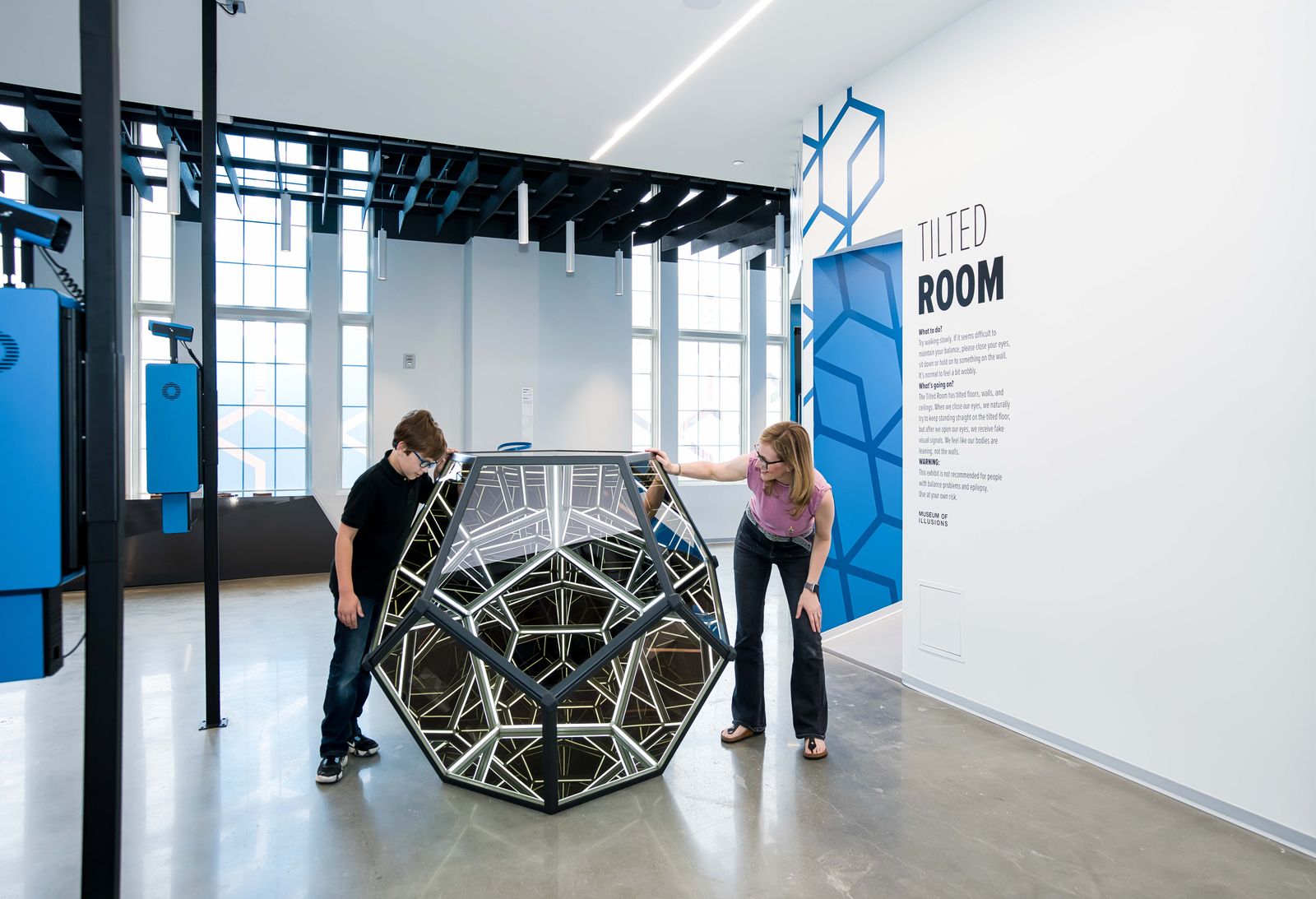
Also, the Infinity Dodecahedron, combines light, mirrors and geometry to create the illusion of endless reflections. What may initially seem like magic is actually an opportunity to explore scientific and mathematical principles in action. As families examine the exhibit, they can discuss how light behaves, how mirrored surfaces interact and how geometric shapes influence what they see.
These hands-on experiences help make STEM concepts more accessible, memorable and engaging.
The educational value of a visit doesn’t have to end when families leave the museum. Parents can extend the experience at home by encouraging children to explain how an illusion worked, research the science behind a favorite exhibit or recreate simple optical illusions using household materials. These conversations help reinforce STEM concepts while fostering curiosity and a lifelong love of learning.
Learn more about the Museum of Illusions, located right in the heart of Cleveland’s Public Square, by visiting moicleveland.com.