


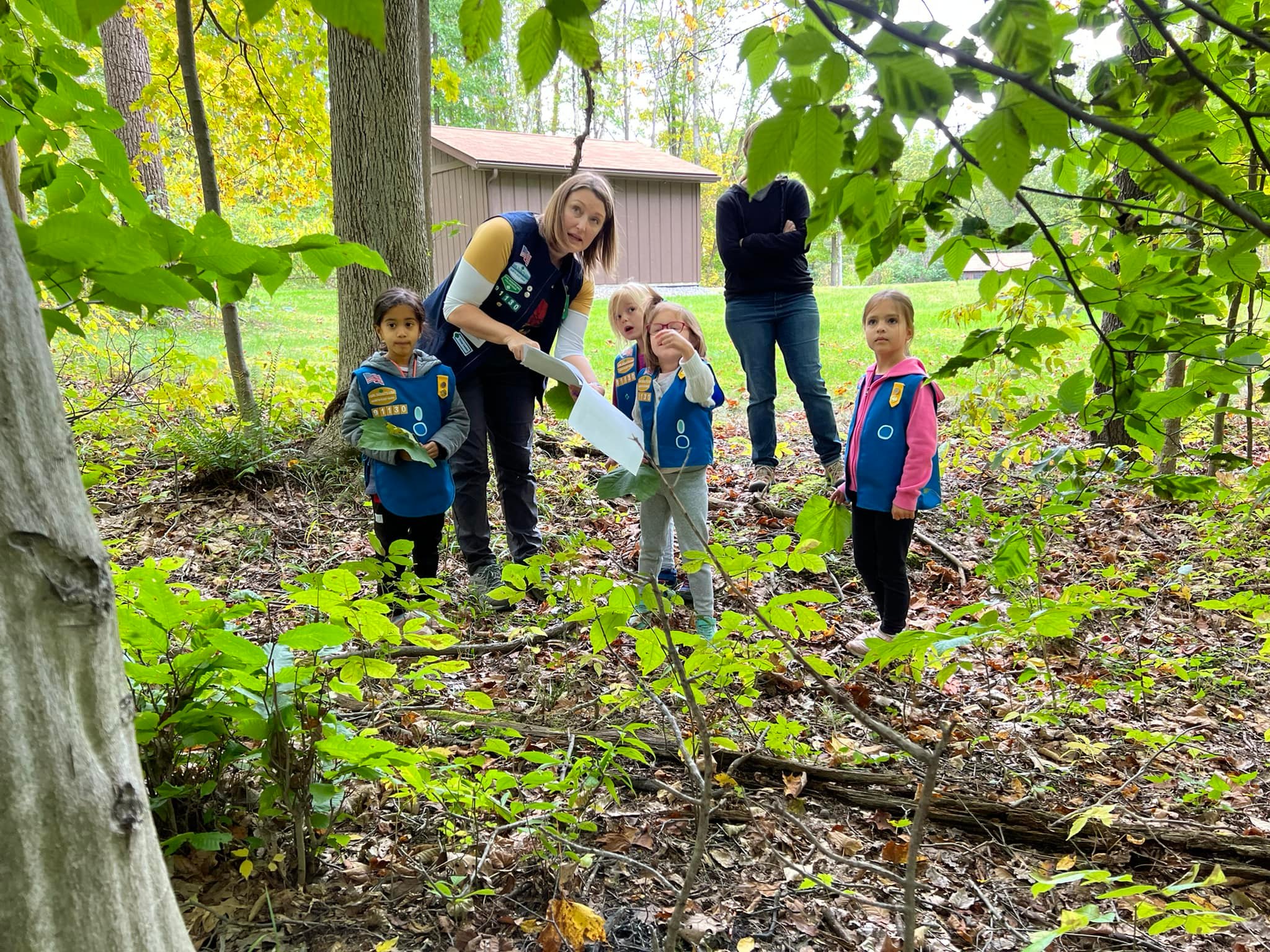
Kids can receive an outdoor education at camp while learning the importance of environmental stewardship. Not only can youth have a positive experience with nature, they can learn practical skills that will help them care for the environment.
Fall in Love with Wildlife
Bethany Beshire, senior manager of Center Operations for Cleveland Metroparks, says environmental stewardship is the concept of investing your own time and energy into caring for our natural world and keeping it healthy, functioning and full of life.
“There are many ways to become an environmental steward, and we believe that encouraging stewardship as a core value in childhood is key to ensuring a healthy planet for future generations,” she says.
“A really big part of building a stewardship ethic is learning to fall in love with the world, even the ‘icky’ parts like spiders, snakes and mud,” Beshire says. “We strive to create emotional connections to nature for children, because without that, you cannot expect them to care. By coupling those intangible concepts like love, protection and reverence with tangible experiences like climbing a waterfall,
discovering nesting birds or performing science experiments, we lay the foundation from which stewardship can sprout.”
This can look like many things: learning about wildlife so that you can understand its importance, planting native gardens to filter water and retain soil health, or discovering how ecologists work to protect our environment.
“The only way you are going to grow to care about nature is from being immersed in it and spending time outdoors,” says Hunter Hammil, outdoor adventure camp manager at Nature Center at Shaker Lakes in Shaker Heights. “If you are spending your entire summer sitting in front of a computer screen or playing video games, you are not going to go outside and develop that personal connection. Those individual moments are life-changing and puts them on the pathway to being environmentally conscious and wanting to continue that as an adult.”
Being Mindful

Dave Devey, director at Falcon Camp, says environmental stewardship can begin by teaching kids to be mindful about food waste, recycling and finding a use for things rather than throwing them away. Camps can also teach good stewardship when it comes to caring for plants and trees.
“Kids can learn about animal habitats, and how to recognize what animals live in the woods by their footprints, living habits and the nests or dens they build,” Devey says.
At Falcon Camp, part of the property is maintained as woods to encourage wildlife, birds and other kinds of animals.
“There is a proper and meaningful way to take care of the environment around us. Not only so we can best use it, but also so that it can be best used for someone 10, 20 or 30 years down the road. So, there is thought and planning that goes into it,” Devey says.
“Part of it is role modeling. We do different things, in a certain way, to model behavior for our campers. We do training with our staff that teaches them to be mindful, and it helps them understand and care for the environment around us. We also teach about nature as part of our program that we call Woodslore, or Lore of the Woods, so our campers can learn about the environment around us,” Devey says.
At camp, kids can participate in hands-on activities that will reinforce environmental stewardship. They can build a small wildlife habitat or help to pick up trash, he says.
Hands-on Learning
An outdoor education at camp can provide campers with information about the outdoors, give them a passion for exploring nature, and equip them with skills, tools and knowledge of nature and the environment.
“Kids are going to actually touch fish, frogs and turtles,” Beshire says. “They’re going to climb deep into ravines, feel the cool moss along a streambed and see the crayfish and insects living in the water. They’re going to learn the best way to catch a dragonfly, build structures and conduct experiments to test scientific concepts, and feel the strength within them as they learn to power and steer their own kayaks.”
“In terms of teaching, when you are able to teach your children some things and you spur their curiosity, they are encouraged to learn more, because they are curious,” Devey says. “They might learn something like this tree is a great tree to have out in the woods, because it provides this kind of food, these kinds of seeds, and this kind of root system to keep things in place. We teach them about plants, what plants can be beneficial and what plants we can use. They also learn about what plants to stay away from. One of the first things kids learn at camp is, ‘Where’s the poison ivy and how do you stay away from it?’”
Leave No Trace
Many camps incorporate the U.S. Fish and Wildlife Service’s “Leave No Trace” principles when hiking or exploring outside.
“If you are camping out in a field or in the woods overnight, when you leave, you want to leave the space the same as when you got there,” Devey says. “So, you don’t leave trash around. You don’t leave litter. You make sure if you have a fire, that you have a safe one and you put it out thoroughly, or if you are on a hike and you cross a stream, you leave it as is.”
The seven “Leave No Trace” principles are: Plan Ahead and Prepare, Travel and Camp on Durable Surfaces, Dispose of Waste Properly, Leave What You Find, Minimize Campfire Impact, Respect Wildlife and Be Considerate of Other Visitors.
“Helping children learn about the environment around them is part of the fabric of who we are,” Devey adds.
Fallon Pulley, chief girl experience officer at Girl Scouts of North East Ohio, says, “Girl Scouts of North East Ohio is steadfast in its environmental stewardship programming. One of our badge series’ content focuses on ways to better our environment by protecting nature and wildlife, treating outdoor spaces with kindness, and by continuing to leave no trace.”
Whether at camp, or at home, she says there are practical things each of us can do.
“While these things are super simple, it can make a big impact in your corner of the world: protect and restore natural habitats, walk more, take public transportation or carpool (you can reduce carbon emissions from your cars this way), conserve water when you can, and use eco-friendly products,” Pulley says.
“We encourage all our campers to embody the Girl Scout Promise and Law,” Pulley says. “The part that sticks out the most when thinking about how we can be better to the planet is ‘use resources wisely, make the world a better place, and be a sister to every Girl Scout.’”
Teaching Care and Protection
Neglect of the environment can lead to pollution and the depletion of resources. Kids can begin to learn about caring for nature and its value through the experiences they have at camp. The things they learn can help them respect the environment and care for wildlife for years to come.
“Making sure the kids learn it’s not just about them and teaching them to care,” Hammil says. “Because if they realize their actions are going hurt others, (such as) if I throw out trash here, that’s going to harm everyone else and the animals that are here, then it makes them more willing and able to do those intentional (good) actions to better for everyone.”
Environmental stewardship in action includes practical steps such as participating in community clean-ups, conserving water, using energy wisely and planting trees, to name a few. Camp can help kids learn these principles at a young age.
“At Girl Scout camp, we do our best to not only promote environmental awareness with our programs, but to also put what’s learned in practice.” Pulley says.
“One of the other reasons to start younger is when you pique the curiosity of campers, and they do have the space to ask more questions, or explore a little further, you’re able to teach more, and those are important things to learn,” Devey says. “Some of the things kids learn are good living habits.”
Beshire agrees, “One of the best things about being in this line of work is getting to see the spark moment when kids ‘get it’ — when they actually connect the dots between themselves, their actions, and the greater world around them. It’s that tiny spark that lights the fire of stewardship within their hearts, and that compels them to want to protect and invest in these special places in nature. That’s the magic of it.”
Whether it’s on a small or larger scale, education can play a key role in environmental stewardship. Campers can not only practice what they learn, but they can share knowledge with their peers, classmates and families.