


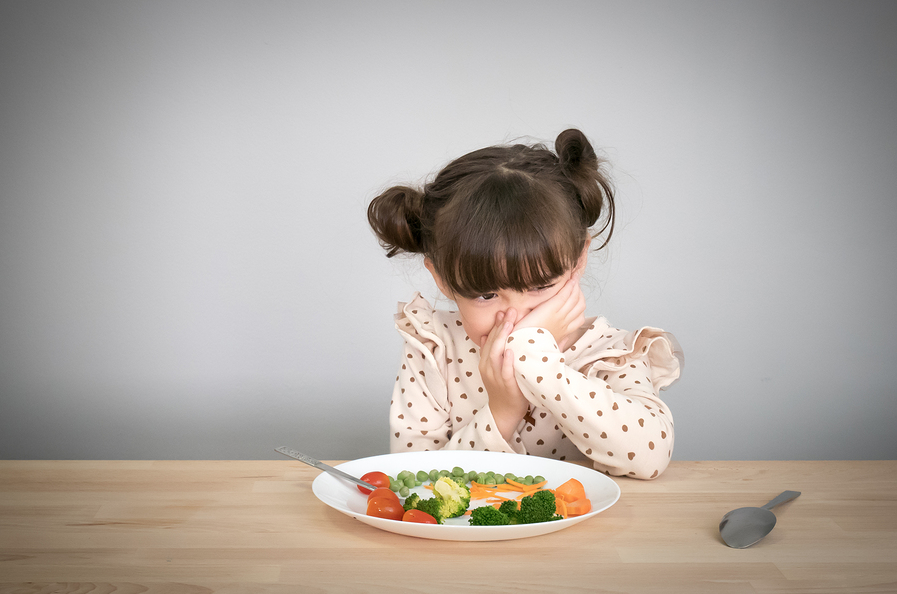
My son once refused to eat shrimp.
I should clarify that this wasn’t an ethical stance. He just didn’t like the taste or texture or something.
Bear in mind, this was after he’d devoured shrimp on several occasions. But this time, he rejected the breaded sea-bugs.
We insisted. He dug in. And dinner crawled to a halt.
For one hour, he sat there with an unchewed mouthful hiding between his molars and cheek.
By the way, I don’t remember how old my son was during “the shrimp incident,” but he couldn’t have been more than 2 years old. Because that’s when our daughter was born, and nobody has time for this sort of nonsense when they have more than one kid.
You probably have a similar story. According to a longitudinal study from Stanford University, anywhere from 13 to 22 percent of kids were reported as being picky eaters at any given age between 2 and 11.
Pickiness is so pervasive that it feels inevitable.
If a child is choosy, what can you do? It’s in their genetics. Kids have different tastebuds anyhow, don’t they? And you don’t want to force your kids to eat something they dislike. You’ll give them a complex.
Helen Zoe Veit — the author of “Picky: How American Children Became the Fussiest Eaters in History” — argues that most of this conventional wisdom is hard to swallow. Veit is a historian and writer, and she spent a decade researching American children’s eating habits.
And her conclusion is that picky eating isn’t genetic, biological or inevitable. It’s cultural.
There was no such thing as “picky” in the 1880s when most kids still worked on the farm and food was only available at mealtimes, Veit concludes.
A confluence of factors contributed to the creation and proliferation of pickiness:
Kids’ calorie needs plunged as they became more sedentary.
Food preparation became easier with the advent of microwaves and prepackaged meals. This mattered because parents could pivot if a child balked at dinner.
Those prepackaged meals were pumped with salt and sugar and scraped of anything that might challenge the palate.
And, as always, marketing fueled this cultural transformation.
Of course, none of this historical context is helpful when your child is staging a one-person hunger strike.
Fortunately, Veit offers more than historical context. Here are her recommendations to parents in a pickle over pickiness:
Discourage snacking. Even your most adventurous diner won’t nosh if they’re not hungry. And they’ll be disinclined to eat what you cooked if they can swap in a favorite snack, instead.
Kids should eat what you eat. (Though, perhaps, in smaller portions.) The notion of kids’ food is a modern invention — supplemented by a robust marketing budget. History is filled with accounts of children devouring what we would consider mature dishes like pickled vegetables and spicy sauces. If they eat what you eat — and if you’re not living on a rotation of chicken tenders, hot dogs and pisketti — they’ll learn to appreciate the varied flavors available to them.
You won’t traumatize your child by nudging them out of their comfort zone. Also, your children won’t starve if they miss a meal. If anything, it’ll motivate them to eat what you offer next time.
Finally, don’t lose confidence. Veit stresses that kids can learn to broaden their diet if you’re consistent.
Let me acknowledge the obvious: I’ve also thrown chicken nuggets into the microwave after a long day. I’ve also been too tired to argue with a child over food.
But the world is filled with weird and wonderful flavors. We’re denying our kids — and, incidentally, ourselves — when we limit the menu.
