


Kids love a little mystery during Halloween season, but not every family wants gore or jump scares. Instead of haunted houses, plan a curiosity-driven road trip to see some of the region’s most cryptic legends.
After all, Northeast Ohio is full of unusual ruins, hidden shipwrecks and strange rock formations that seem like something out of a ghost story — until you dig into the real history behind them. Here are 7 mysterious spots where real-world history proves far more fascinating than any myth.
1. Lake Erie: A Shipwreck Graveyard

Why it Seems Eerie
Looking out over Lake Erie’s calm surface from the shore, it’s hard to imagine that directly beneath the waves lie hundreds — perhaps thousands — of lost ships. Stories of phantom ships, sudden violent storms, and vanishing vessels have circulated among Great Lakes sailors for centuries.
What the Truth Actually Is
Lake Erie is home to an estimated 500 to 2,000 shipwrecks, making it one of the densest shipwreck locations in the world, according to NASA. However, the cause is a combination of geography and weather physics, rather than supernatural forces.
Lake Erie is the shallowest of all the Great Lakes, averaging only 62 feet deep. Because it holds less water volume, sudden autumn cold fronts can whip up large, steep waves in a matter of minutes. In the 19th century, before modern radar and GPS, heavy fog and gale-force winds easily drove wooden schooners and early steamships into hidden sandbars and rocky reefs. Other common causes of foundering here included collisions and fires, according to NASA. Today, cold freshwater preserves these sunken ships like underwater time capsules.
Where to Visit
National Museum of the Great Lakes, Toledo: Take a day trip to this spot, which features interactive maritime displays, actual artifacts recovered from famous wrecks, and the Col. James M. Schoonmaker museum ship. nmgl.org
Fairport Harbor Marine Museum & Lighthouse: Climb the historic 1871 lighthouse tower for a bird’s-eye view of the lake while learning about historic rescues. fairportharborlighthouse.org
2. Abandoned Canal Locks: Ghost Towns of the Towpath
Why it Seems Eerie
Walking along Cuyahoga Valley National Park trails, you might stumble upon massive stone walls sitting silently in the woods. They look like ancient, abandoned ruins from a forgotten civilization. Local legend often paints these quiet stretches as eerie “ghost towns” where thriving communities suddenly vanished into thin air.
What the Truth Actually Is
These stone structures are the remains of the Ohio & Erie Canal, built between 1825 and 1832 to connect Lake Erie to the Ohio River. By connecting Ohio to New York and New Orleans, the canalway helped fuel westward expansion, a national market economy and a booming industrial market. It also defined the settlement of numerous towns, villages and cities and attracted many businesses because of the viable transportation route it offered, according to the Ohio & Erie Canalway Association (ohioanderiecanalway.com).
The stone structures, or locks, functioned as water elevators, allowing canal boats carrying grain, coal and passengers to navigate Ohio’s changing elevation. Towns didn’t vanish overnight; they evolved. When steam locomotives arrived in the mid- to late 1800s, rail transport proved faster and cheaper than mule-drawn canal boats. A catastrophic statewide flood in 1913 — considered the second deadliest flood in the United States, according to the Ohio & Erie Canalway Association — damaged much of the canal system, officially bringing the canal era to an end.
Where to Visit
Canal Exploration Center, Valley View: At this interactive museum inside a historic 1852 tavern and canal store, kids can try hands-on exhibits demonstrating how water locks operate. nps.gov/cuva
Lock 29 Trailhead, Peninsula: Walk right alongside the impressive sandstone lock walls and cross the footbridge to see how the canal integrated with the river. nps.gov/cuva
3. Squire’s Castle: A Haunted Fortress?
Why it Seems Eerie
Deep in the Cleveland Metroparks North Chagrin Reservation stands a stone castle complete with towers, arched windows, and empty doorways leading into shadowed rooms. Local folklore claims the castle is haunted by the owner’s wife, who died in the home and remains as a supernatural resident, according to Cleveland Historical (clevelandhistorical.org).
What the Truth Actually Is
The ghost story is pure fiction. The structure was built in the late 1890s by Standard Oil executive Feargus B. Squire as a gatehouse for a grand country estate he planned to build on his 525-acre property. Squire eventually abandoned plans for the main mansion because building and maintaining such a massive rural estate proved impractical — and because his wife, Rebecca, hated the idea of country living, according to Cleveland Historical.
The couple instead built an estate in Wickliffe and sold the 525 acres to a private developer in 1922, after which it was acquired by Cleveland Metroparks in 1925. The park district removed the inner wooden floors and roof for safety, leaving the sturdy stone exterior kids love to explore today. Cleveland Historical states that Rebecca died of a stroke in Wickliffe in 1929, several years after the castle property was sold.
Where to Visit
Cleveland Metroparks North Chagrin Reservation — Squire’s Castle Picnic Area, Willoughby Hills: Families can walk inside the stone interior, explore the surrounding hiking trails, and enjoy a picnic on the expansive open lawn directly in front of the castle. clevelandmetroparks.com
4. Glacial Grooves: Nature’s Giant Chisel
Why it Seems Eerie
On Kelleys Island, a massive, smooth trench looks as though a giant mythological creature dragged its claws and left marks deep in the solid bedrock. The sheer size and precision of the scoops in the limestone look unnatural at first glance.
What the Truth Actually Is
The grooves were actually formed during the Ice Age. Approximately 18,000 years ago, a massive continental glacier — a sheet of ice over a mile thick — slowly moved across what is now the Lake Erie basin. As the glacier advanced, it picked up heavy granite boulders and hard quartz sand. Trapped underneath the immense weight of the ice, these hard rocks acted like giant sandpaper, carving and grinding deep troughs into the softer limestone bedrock.
Measuring nearly 400 feet long and up to 10 feet deep, the “megagroove” on Kelleys Island is widely considered to be among the largest and most easily accessible set of glacial grooves in the world, according to the Ohio Department of Natural Resources (ohiodnr.gov).
Where to Visit
Glacial Grooves Geological Preserve, Kelleys Island State Park: Accessible via a short ferry ride from Sandusky or Marblehead, the site offers a newly updated system of elevated walkways, bridges and stairs that allow visitors to look straight down into the grooves without damaging the delicate rock. ohiodnr.gov
5. Lake View Cemetery: The Angel That Weeps
Why it Seems Eerie
With towering gothic monuments, twisting wooded paths, and famous historical residents, Cleveland’s Lake View Cemetery looks like the setting of a classic thriller. However, it’s the “Haserot Angel” — a life-sized bronze statue of an angel that appears to weep black tears from its eyes — that garners the most local lore. Seated at the grave of the Frances Haserot family, the angel holds a torch upside down, a symbol of life extinguished, according to Lake View Cemetery.
What the Truth Actually Is
Founded in 1869, Lake View was designed as a “rural cemetery” — a 19th-century urban design movement intended to create peaceful, park-like botanical gardens where families could picnic and reflect in nature. While the cemetery contains the remains of over 112,000 people and includes such prominent individuals as President James Garfield and John D. Rockefeller, the Haserot family plot attracts thousands of visitors.
The Haserot Angel, actually named “The Angel of Death Victorious,” was created by sculptor Herman Matzen in 1924. The weeping effect is actually chemical weathering: according to the National Park Service, bronze is an alloy composed primarily of copper, and when exposed to air, moisture and environmental pollutants over time, the outer layer oxidizes and forms a protective patina. This chemical reaction creates the dark green, black and streaked appearance seen on outdoor bronze statues. As rain and condensation collect in the deep crevices of the Haserot Angel’s eyes and face, the oxidized copper compounds run downward, producing the dark, dramatic streaking effect, according to the Cleveland Architecture Foundation (clevelandarchitecturefoundation.org).
Where to Visit
Haserot Family Plot — Lake View Cemetery, Cleveland: Centrally located, the Haserot Angel can be found slightly north and equidistant from the Euclid Avenue and Mayfield Road entrances of the cemetery. lakeviewcemetery.com
Other points of interest — Lake View Cemetery, Cleveland: There are many other must-see spots while you’re visiting, including the James A. Garfield Memorial, Wade Memorial Chapel, plus memorials and gravesites of Elliott Ness, John D. Rockefeller and Alan Freed, among other notable figures. lakeviewcemetery.com
6. Worden’s Ledges: Mysterious Rock Carvings
Why it Seems Eerie
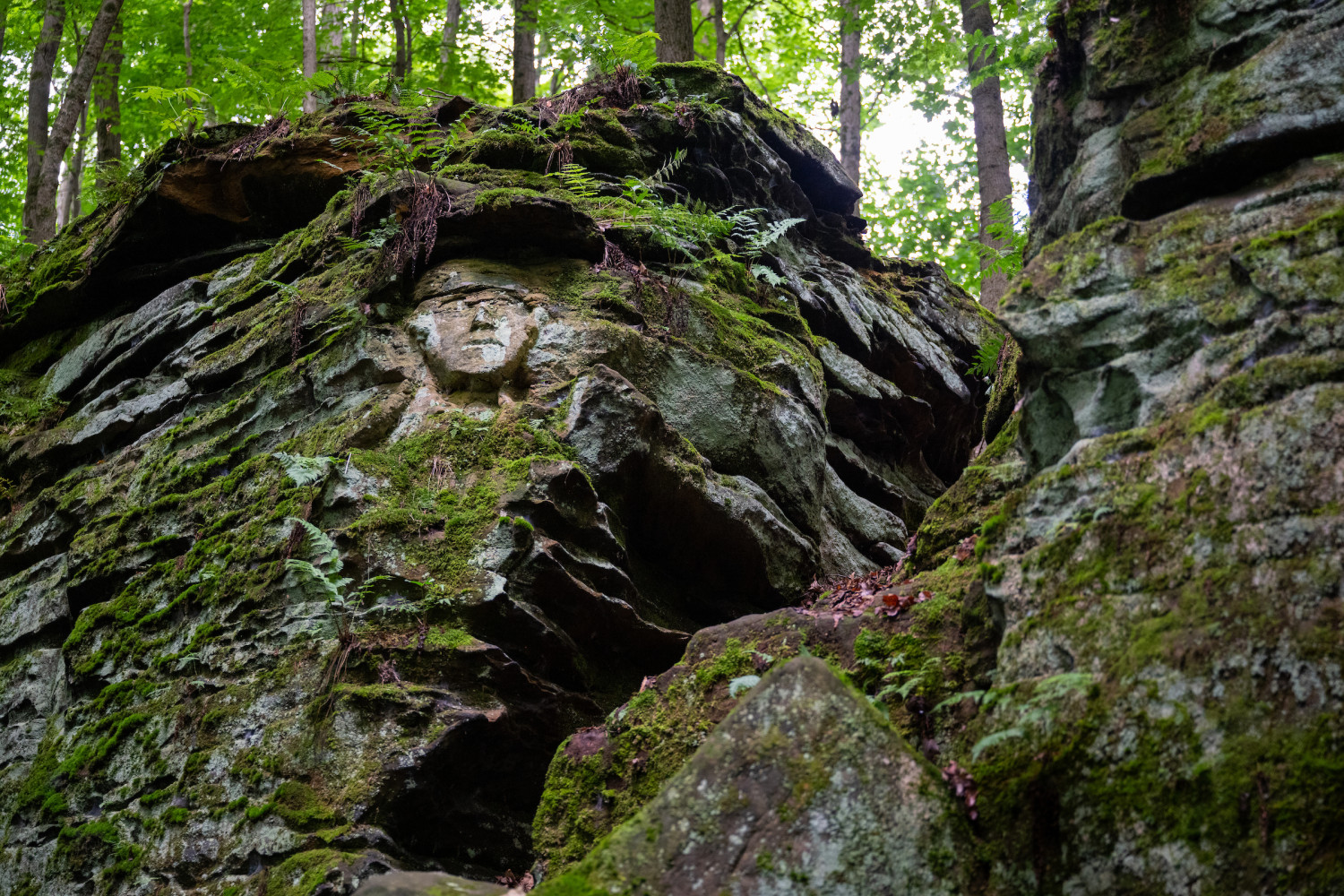
Tucked along a quiet, wooded trail in Hinckley, large sandstone cliffs rise out of the earth. As you walk past the massive moss-covered rocks, you might feel as if you’re being watched. Then you’ll discover carvings of human faces, sleeping figures and other symbols on the stone walls.
What the Truth Actually Is
These carvings aren’t spooky mysteries — they were created by a local folk artist named Noble Stuart, son-in-law to the namesake of the ledges, Hiram Worden. In the 1940s, using simple chisels and hand tools, he carved directly into the exposed sandstone ledges portraits of people and symbols that inspired him, including the faces of George Washington, Thomas Jefferson and Ty Cobb, as well as a sphinx and a ship’s anchor.
Where to Visit
Worden’s Ledges Trail, Cleveland Metroparks Hinckley Reservation: The relatively easy, 0.4-mile loop trail winds around the rock ledges. Kids will love turning the hike into a scavenger hunt to find the hidden carvings. clevelandmetroparks.com
7. The Seville Giants: a Larger-Than-Life Love Story
Why it Seems Eerie
Tucked away in Seville’s historic Mound Hill Cemetery stands an extraordinarily tall monument that towers over a quiet burial plot. Local campfire tales and whispers of circus lore often paint the “Seville Giants” as mysterious figures shrouded in eerie Victorian oddity. Standing in front of their gravesite, it’s easy to imagine a dark tale about the giant couple buried below.
What the Truth Actually Is
The gravesite belongs to Captain Martin Van Buren Bates and Anna Haining Swan Bates, real-life historical figures who stood at 7 feet 9 inches and 7 feet 11 inches tall, respectively. The pair, who still hold the Guinness World Record for the tallest married couple in history, met while working as famous touring performers for P.T. Barnum’s circus and exhibition shows, traveling the globe and even performing for Queen Victoria in England, according to TourismOhio (ohio.org).
Seeking a quiet, peaceful life away from the spotlight, they moved to Seville, in Medina County, in 1872. They built a custom home featuring 14-foot ceilings and 8-foot doorways so they could live comfortably. Far from being mysterious recluses, Martin and Anna were deeply loved by their neighbors and were known for their hospitality, involvement in the local church, and generosity toward neighborhood children.
Where to Visit
Mound Hill Cemetery, Seville: Walk through the grounds to view the Bates family plot — also the resting place of their infant baby, who weighed nearly 24 pounds and measured 30 inches long at birth, but only lived for 11 hours — and the stone monument erected by Captain Bates in memory of Anna. guilfordtownship.us
Seville Historical Society Museum: Located nearby in downtown Seville, this museum holds a fascinating collection of the couple’s actual belongings, including custom-made oversized furniture, clothing, boots and historical photographs. facebook.com/sevillehistoricalsociety